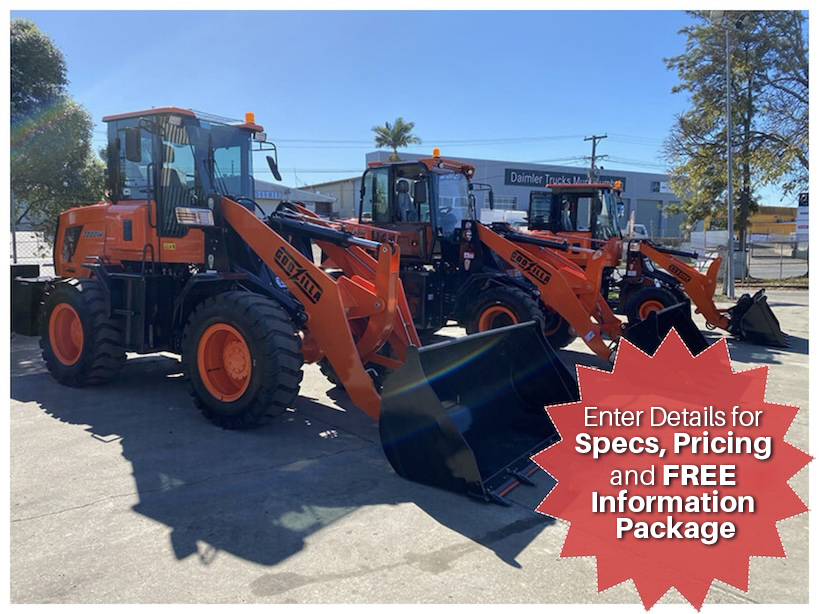
Front end loaders are designed to move, lift and place materials using a loader arm and front attachment. Typical jobs include handling soil, gravel, mulch, manure, firewood, pallets and other materials. With the right attachment, a loader can also take on jobs such as vegetation management, spreading, material handling and property maintenance.
The first step is to think about the work rather than the machine name. Ask how much material you need to move, how high you need to lift it, how often the loader will be used, what ground conditions it will encounter and which attachments you are likely to run. These answers help narrow the useful range far more effectively than choosing a loader based on appearance or engine size alone.
Why articulated front end loaders are useful
Articulated loaders are valued for manoeuvrability and for their ability to work efficiently where a rigid machine may have more difficulty positioning. On farms and acreage, that can mean moving materials around sheds, yards and tracks. On worksites, the same flexibility can be useful when loading, backfilling or shifting loose material.
For businesses, versatility is another important consideration. A loader fitted with a general-purpose bucket can handle everyday material movement, while forks can make pallet and bundled-material handling easier. Four-in-one buckets, slashers, rippers, mulchers and other attachments can extend the range of work a suitable machine can perform.
Choosing the right loader size
Loader size should be based on the relationship between operating weight, rated load capacity, physical dimensions and the environment in which the machine will work. A compact loader may be easier to manoeuvre around a smaller property, while a larger machine can be more appropriate when heavier loads and higher productivity are central to the job.
Godzilla Loaders currently lists a broad range of wheeled loader models, including the 1000W, 1600W, 2500W, 3000W and 4000W, as well as larger Super Strong models. The listed range also includes mini loaders, skid steer loaders, a backhoe loader and a telehandler, giving buyers several equipment categories to compare. Always check the manufacturer's current specifications and package inclusions before making a purchasing decision.
Attachments can change the job completely
The attachment system deserves as much attention as the loader itself. A machine that can quickly change between buckets, forks and task-specific equipment can reduce the need for multiple specialised machines.
Depending on the loader model, Godzilla's current attachment range includes options such as hydraulic slashers, cement mixers, hay forks, log grabs, augers, light-material buckets, stick rakes, trenchers, mulchers, rippers, sieve buckets and other tools. Availability and compatibility vary by model, so confirm the attachment is correctly matched to the machine before ordering.
Think about your everyday materials
Make a short list of the materials you move most often. Soil and gravel may favour a conventional bucket configuration. Pallets and packaged goods may make forks important. Firewood and logs can require a different attachment strategy. Vegetation work may call for a slasher or mulcher. If your workload changes through the year, attachment flexibility can become one of the most valuable features of the machine.
Front end loaders for farms and acreage
On a farm or large property, a loader can be used for jobs that would otherwise require repeated manual handling or contractor visits. Material movement, maintenance, landscaping, feed or bedding handling, track work and general property projects are common reasons owners consider a loader.
The important point is to size the machine around the property. Think about gates, sheds, paddock access, slopes, ground clearance, storage and transport. A loader that technically has more capacity than you need can still be the wrong choice if it cannot comfortably access the places where you work.
Front end loaders for construction and earthmoving
For construction and earthmoving applications, productivity becomes a central consideration. Cycle times, bucket size, lifting capacity, dump height, manoeuvrability and attachment compatibility all influence how efficiently a machine can perform repeated material-handling tasks.
Operators should also consider site traffic, visibility, ground conditions and the interaction between the loader and other equipment. Safe separation from people, correct load handling and following the manufacturer's operating instructions are essential parts of loader operation.
Buying a front end loader: a practical checklist
- Write down the five jobs you expect to perform most often.
- Estimate your typical and maximum load requirements.
- Measure the narrowest access point and storage area.
- Check lift height and reach against your real loading tasks.
- List the attachments you need now and the ones you may add later.
- Compare the complete package, not just the headline machine price.
- Consider delivery, finance, warranty, service and after-sales support.
- Use video tours and product documentation to understand the machine before purchase.
Compare current loader information before deciding
Godzilla Loaders publishes current loader pricing and package information online. Its price list includes the 1000W through 4000W wheeled loader range and larger Super Strong models, alongside mini loaders and skid steer equipment. Because prices and specifications can change, the live price list should be treated as the reference point for current figures rather than an old article or cached comparison.
For buyers who prefer to see a machine operating before making a decision, the company's video-tour resource provides model-by-model information, while its catalogue resource can be used to request a more complete information package. Reviews can also provide useful customer-experience context, but individual reviews should be considered alongside specifications, warranty information and your own application requirements.